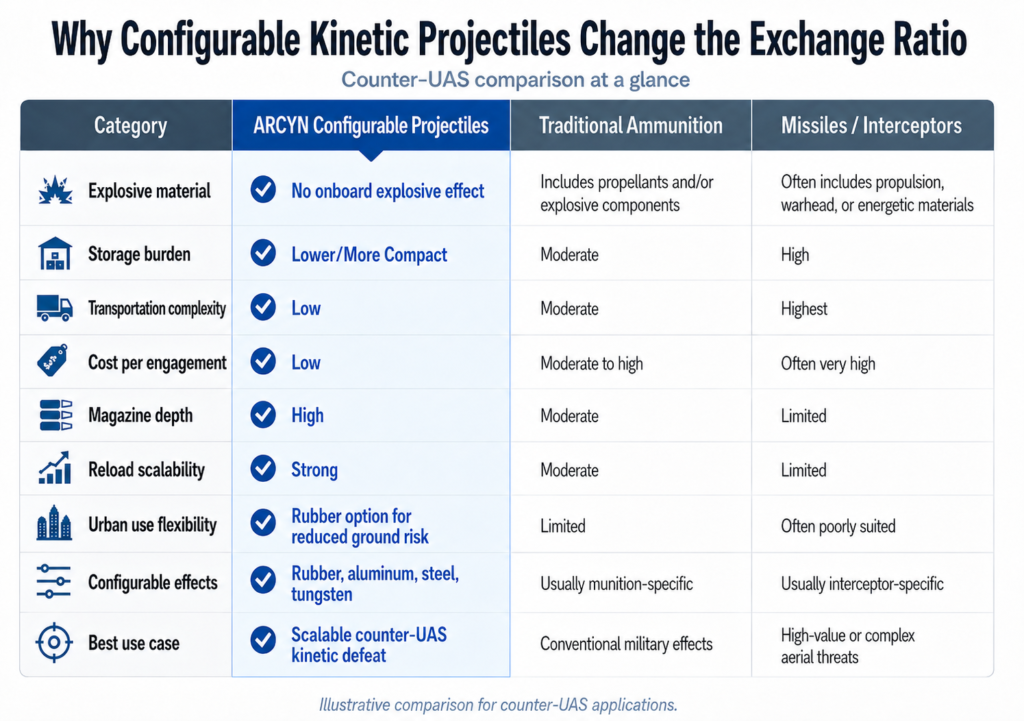

Why ARCYN’s Configurable Projectiles Change the Counter-Drone Equation
Most counter-drone conversations start with detection, targeting, autonomy, or electronic warfare. Those are all critical pieces of the problem, but they do not answer the question that eventually comes for every commander, base security team, or infrastructure operator: what are we actually going to fire?
That question is becoming harder to ignore. Small unmanned aircraft are cheap, numerous, adaptable, and increasingly difficult to defeat with a single layer of defense. They can be launched in groups, modified quickly, and used in ways that force defenders into costly responses. In too many cases, the economics favor the attacker. A relatively inexpensive drone can force the defender to expend a munition that is far more expensive, more difficult to replace, and more burdensome to move, store, and maintain.
Traditional military munitions are powerful for good reason. They were designed for serious military effects against serious military targets. But they also carry a long operational tail. Many involve energetic materials, including propellants and high explosives, fuzes, complex warheads, hazard classifications, compatibility rules, restrictive rules of engagement, specialized packaging, inspection cycles, security requirements, certified transportation, shelf-life management, disposal, and demilitarization.
The sticker price of a munition is only part of the real cost. The rest shows up in depots, shipping paperwork, explosive safety arcs, storage limits, handling procedures, trained personnel, restricted transport routes, and long-term lifecycle management. For major combat systems, that complexity may be unavoidable. For routine counter-drone defense, especially against small and inexpensive threats, it creates a bad exchange ratio.
ARCYN Defense is approaching the problem differently with Iron Rain™, a new class of kinetic counter-UAS system.
The design logic is straightforward: put the energy in the flywheel, not inside the cartridge’s chemical propellant.
ARCYN’s patent-pending rifled dual-flywheel architecture is built to impart extreme kinetic energy at launch. That allows the projectile itself to remain mechanically simpler, materially configurable, and mission-specific. Instead of designing every round around chemical energy, Iron Rain uses the launch system to create the speed, stability, and kinetic effect needed to defeat aerial threats.
That is a major distinction. A projectile that does not carry chemical propellant, explosive filler, a shell charge, or a complex warhead is not the same logistical object as a rocket, missile, or explosive round. In contrast, it does not create the same energetic-material burden that drives so much of the weight, volume, packaging complexity, transportation restrictions, storage requirements, and lifecycle management associated with traditional munitions.
Compared to traditional bullets and explosive acceleration, Iron Rain’s projectile can reach hypersonic speeds due to a longer acceleration time.
The flywheel system is the competitive advantage that makes this possible. Simple projectiles are only valuable if they can be launched with the velocity, repeatability, spin, and control required for real-world engagements. ARCYN’s rifled dual-flywheel design is intended to deliver that launch energy externally while supporting a family of projectile types that can be matched to the target, terrain, altitude, range, and collateral-risk environment.
This is where configurable kinetic effects become important.
Rubber projectiles are suited for dense urban environments, public venues, airports, critical infrastructure, and other areas where people and property may be below the engagement zone. They are designed for shorter-range engagements and, due to the hypersonic properties of the design, can break apart in flight, reducing collateral risk on the ground after the intercept.
Aluminum provides a lighter projectile option where speed, volume, a more controlled kinetic profile, and limited range are priorities. In some scenarios, operators may not need the mass of steel or tungsten. Aluminum gives the system another way to balance velocity, safety envelope, cost, and effective range.
Steel is the practical workhorse. It is durable, cost-effective, widely understood, and capable of delivering stronger kinetic performance across a broad range of common drone threats. For bases, ports, airfields, border zones, and fixed-site defense, steel can provide a balanced mid-range option for repeated engagements.
Tungsten’s mass and energy retention make it better suited for longer-range, higher-altitude, faster-moving, or more demanding targets. At the upper end of the velocity envelope, tungsten supports extended ballistic engagement profiles where distance, stability, and retained kinetic energy are the priority.
Range is not a single number. It is shaped by projectile material, mass, geometry, spin, launch velocity, atmospheric conditions, target altitude, target speed, and the safety envelope around the engagement. A rubber projectile over a crowded city should not behave like a tungsten projectile launched across open battlespace. The munition should fit the mission, not the other way around.
That flexibility is central to Iron Rain. A drone over a stadium, a drone approaching a forward operating base, a drone near a port, and a drone moving toward critical energy infrastructure all present different risks. Each may call for a different projectile, different engagement distance, and different tolerance for debris or overtravel. A configurable projectile architecture gives operators more choices instead of forcing them into a single effect.
The broader defense problem is not just that drones are small and cheap. It is that the systems used to defeat them must be effective and sustainable under pressure. A counter-UAS platform that works once is not useful. A platform that can engage repeatedly without draining missile stocks, expanding explosive storage burdens, or creating a transportation and demilitarization problem is far more valuable.
Traditional munitions will continue to play a vital role. Some targets require explosive effects, guidance packages, specialized warheads, or other advanced capabilities. But the counter-drone fight also needs a physical defeat layer that is faster to reload, easier to scale, less expensive per defeat, and better suited for large numbers of low-cost aerial threats.
That is the role ARCYN is building toward.
Iron Rain pairs a high-velocity kinetic launch system with configurable projectiles that can be adapted to the environment and the target. The result is a different way to think about air defense: less dependence on complex energetic munitions, deeper magazines, lower logistics burden, and a better cost curve against one of the most scalable threats on the modern battlefield.