

Jammers do not always work. Missiles cannot be the answer to every cheap drone.
Jamming is a great answer until the drone ignores it.
Some aircraft lose their control link, drift, land, or turn home. Others keep flying. They may be following a preplanned route, switching connections, or relying more heavily on onboard autonomy. Joint Interagency Task Force 401 recently put the point plainly: jamming is neither predictable nor guaranteed, and fully autonomous drones may be less affected.
If the aircraft keeps coming, the defender needs a hard kill.
The obvious answer is a missile. It is also an expensive habit. Long-range interceptors are built to take on aircraft, cruise missiles, and ballistic missiles. Every one spent on a small drone is one less available for the threat it was designed to stop. Recent Army demonstrations of lower-cost counter-UAS systems have made the same point explicitly: defeat low-cost drones without consuming the long-range interceptors reserved for more dangerous threats.
Commanders need something between a failed jammer and a premium missile.
The Fight After the First Shot
Counter-drone demonstrations end when the target falls. In combat, that is often when the next problem starts.
Another drone may already be inbound, followed by decoys, different flight profiles, or a second wave from another direction.
After the first kill, logistics takes over. The crew needs enough ammunition, a fast reload, manageable storage and transport, and a supply chain that can replace what was fired. One clean intercept followed by a long resupply delay offers little comfort during a sustained attack.
Traditional interceptors pack propulsion, guidance, sensors, energetic materials, and specialized components into each round. Those systems earn their keep against high-end threats. Against cheap mass, the trade turns ugly.
Air defense needs a physical defeat option built for repetition. U.S. Army analysis has similarly highlighted limited magazine depth, reload constraints, and the need to layer counter-UAS capabilities across the battlefield.
Where Iron Rain Fits
ARCYN Defense is developing Iron Rain™ for this part of the fight.
Its design uses a rifled dual-flywheel architecture to generate launch energy in the weapon rather than carrying chemical propellant inside every projectile. More of the complexity stays in the reusable platform. The round can remain mechanically simpler and be configured for the mission.
ARCYN is designing the system to support deeper magazines, rapid follow-on engagements, and a reduced logistics burden compared with traditional energetic munitions. Projectile characteristics can be tailored for different targets and operating environments. A round suited to open battlespace may be wrong for an airfield, port, or other site where debris and overtravel require tighter control.
The launcher is being paired with AICUS, ARCYN’s edge-AI platform for sensor fusion, detection, classification, tracking, and trajectory prediction. AICUS is designed to help operators identify the threat, follow its path, and support the firing solution.
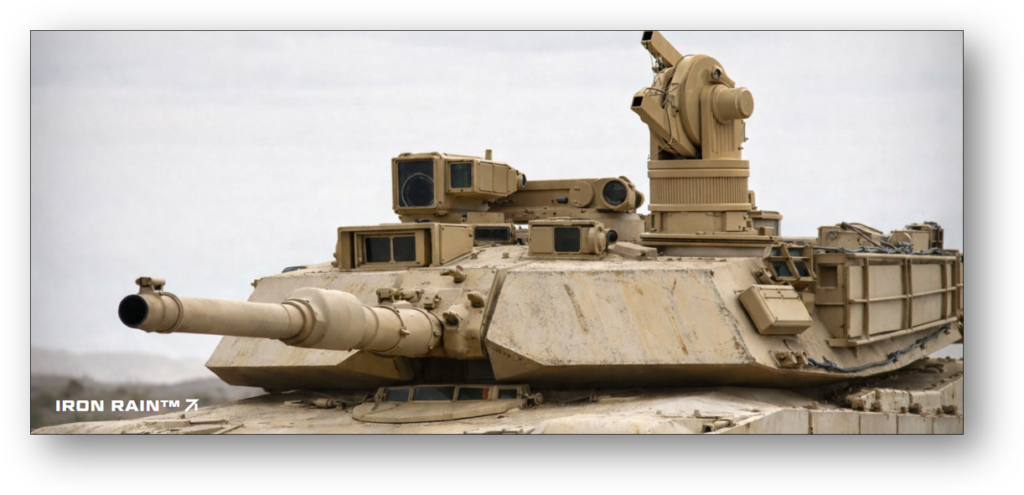
Electronic warfare, directed energy, missiles, and other kinetic systems all have a place in layered defense. NATO recently tested precisely this kind of integrated architecture, combining sensors, electronic warfare, and kinetic and non-kinetic effectors in realistic counter-drone scenarios. ARCYN has given Iron Rain a clear job: stop the drone without turning every engagement into a missile shot.
The Hundredth Drone
Test footage captures the first intercept. The harder question comes later, when targets keep arriving, crews are reloading, and the missile inventory is being held for something worse.
The first intercept makes the demo reel.
The hundredth keeps the base in the fight.
ARCYN Defense is building Iron Rain for the hundredth.